What it is
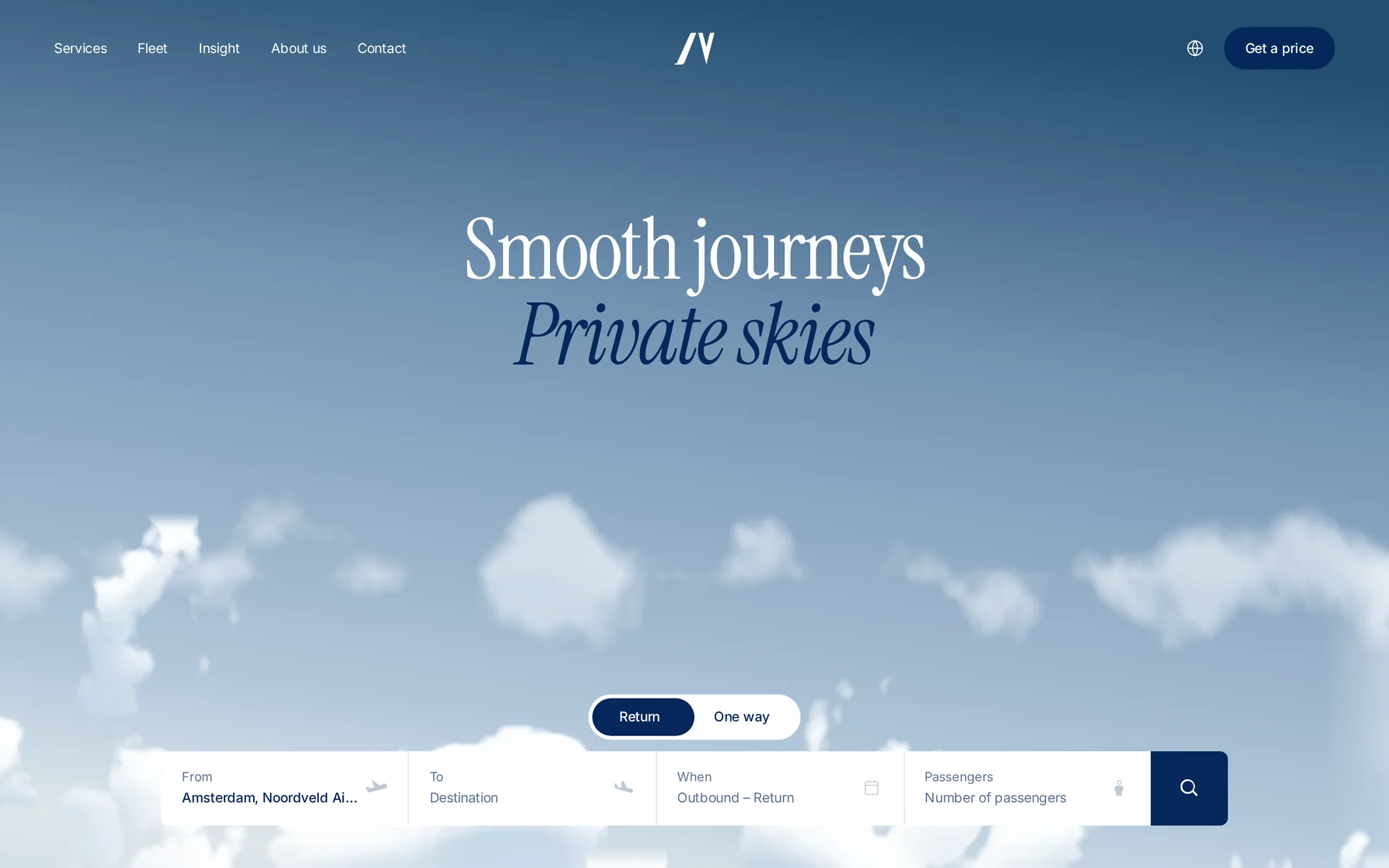
A private jet operator's site, complete: a hero over an animated sky with a flight search, an intro, a “your flight step by step” sequence in three full-page photographs, services, an aircraft window that opens until it fills the screen, the fleet, a globe of destinations, the company's history, news, Instagram, a quote request, a footer. One page, one HTML file.
The design follows that of a Dutch business aviation site, of which only the photos have been kept. All the code has been rewritten: the original comes in 28 Next.js bundles (2.7 MB), GSAP and its ScrollTrigger module, three.js for the globe (1.8 MB on its own), Lenis for inertial scrolling, Swiper for the carousels, 196 kB of compiled Tailwind and three analytics domains. Unreadable, and impossible to change without running a build chain again.
The demo's content stays in Dutch, as in the original. That isn't an oversight: a template reads better when the text isn't mock Latin.
What you change first
The colours — six lines
Right at the top of assets/css/style.css:
--navy:           #05275b;  /* text, solid buttons, pins */
--navy-dark:      #071831;  /* the window's scrim */
--cloud:          #fcfdfe;  /* the page background */
--accent:         #0069c8;  /* eyebrows, focus */
--accent-strong:  #004e96;  /* hover on solid buttons */
--accent-light:   #5eb2ff;  /* the same blue, lightened for text over photos */
One thing to grasp before touching anything else: there are three accent blues, not one. The solid accent passes AA contrast on the cloud white (5.35:1), but it vanishes into the sky of a photo. That's why the lightened version exists (7.84:1 on the midnight blue). If you change the accent, change all three.
The sky itself is a four-stop gradient, taken as it is:
linear-gradient(#214c6f -10%, #7495b5 33.18%, #b4cadd 70.2%, #e5eaf0 100%).
The name
Search for “Aerivo” in index.html. No CSS class carries the brand name: a find-and-replace can't break anything.
The sizes
The type scale is declared once, then redeclared at each of the four breakpoints — 1200, 991, 767 and 479 px, the original site's. So a heading never gets its own media query: you change
--fs-h2 and the whole page follows.
The 22 effects, and how they're built
All taken from the original site by script, not by eye: its GSAP settings are carried by data-* attributes on the elements themselves, which gives the exact durations, curves and scroll ranges. Whatever wasn't there was measured in the browser.
| Effect | Where | How |
|---|---|---|
| Opening curtain | whole page | a scrim pierced by a pill-shaped hole that grows until it swallows everything — mask-composite: subtract |
| Scroll reveal | 12 blocks | IntersectionObserver, firing 15% up from the bottom of the screen |
| Word-by-word reveal | 9 headings | the JS splits into numbered words, the CSS turns the number into a 50 ms delay |
| Cloud parallax | hero, 3 layers | −90%, −80% and −60% of run, at scales 1 / 1.06 / 1.12 |
| Endless cloud drift | hero, window | @property --drift: with no declared syntax, a variable jumps instead of gliding |
| Search bar descent | home | 70 vh of run, driven by the block's progress |
| The frame widens | sequence | from the content width to the whole screen, and the corner radius falls to zero |
| Three stacked photos | sequence | position: sticky on three items of a list |
| Progress dots | sequence | the active dot stretches into a bar (600 ms) and fills as you scroll |
| Carousels | services, fleet | native scroll-snap: dragging, swiping and the keyboard all work without JS |
| The window opens | “The sky is yours” | a mask from 320 px to 152 vmax: the midnight-blue scrim is pierced in the shape of the window |
| Diagonal heading | window | it crosses the screen corner to corner over the section's 200 vh |
| The globe | destinations | the same equirectangular texture as the original, on a disc shaded by three gradients |
| Pins that move with it | destinations | the scroll turns the texture by 30% and offsets the pins by as much |
| Cloud bands | globe, quote | the same band flipped, in parallax — the rotation goes into the transform, not beside it |
| White joining scrim | globe, quote | it retracts as the block arrives, so the seam is never visible |
| Photo parallax | sequence, history | image enlarged by 10% so the drift never shows an edge |
| The quote panel rises | quote | 120% of run over the crossing of the section |
| Retractable navigation | everywhere | it hides going down, comes back coming up, 400 ms |
| Navigation pill | everywhere | the white background appears once the first screen has passed |
| Link hover | navigation | the word slides upwards, its copy takes its place |
| Return-trip selector | home | two radio buttons and :has() — the pill slides without a line of JS |
What you should know
-
A single mechanism drives all the scrolling. The script writes
--p, a number between 0 and 1, on every block carryingdata-track; the CSS uses it as it likes. Three ways of measuring it — as the block arrives, over its crossing, or while it's taller than the screen. To add a parallax: one attribute on the container, onecalc()on the child, zero lines of JavaScript. - No external requests. Checked by serving the folder over HTTP: 0 requests outside the folder. The original makes them to three analytics domains and a storage bucket.
-
Without JavaScript, nothing is hidden. The hidden state only exists once the script has run. Checked by removing the
<script>: 15 headings out of 15 and 17 paragraphs out of 17 stay visible, the curtain doesn't exist, the menu is a list. -
Zero inline styles, zero inline scripts. The template honours the site's strict security policy, checked by serving the folder with the header: 0 violations. That explains one peculiarity of the globe — the twelve pins are placed by
:nth-child()in the stylesheet, because thestyleattribute is blocked. -
No
animation-timeline, which only exists in Chrome. Everything goes throughIntersectionObserverand a CSS variable. -
Accessibility: skip link, menu state announced and closing on Escape, carousel positions announced, visible focus, decorations hidden from screen readers, and
prefers-reduced-motionwhich resets the durations and the delays to zero. - Responsive checked at 390, 1440 and 2560 px, on load and after scrolling all the way down, with no horizontal overflow.
What isn't perfect
Better said here than left for you to find out.
-
The globe isn't a sphere. The original renders it in WebGL: a real projection, pins that disappear at the edge, free rotation. Here it's a disc dressed in the same texture, shaded by three gradients. The silhouette and the pins are there, the distortion at the edges isn't. The cost of full fidelity: 1.8 MB of library and a
<canvas>no student can read back. - The opening curtain lasts 1.2 s instead of 5.4 s. The original blocks scrolling, waits for the globe to load then for six cloud images to decode: five and a half seconds of blank screen before the first word. That's a flaw, not a decision.
- No inertial scrolling. The original goes through Lenis. One more dependency for a comfort half of all visitors find annoying.
- The flight search form searches nothing. It pointed at a proprietary pricing engine; it's now a link to the quote block. The fields are still editable and the return-trip selector works without JavaScript.
- The page is 0.3 to 3.3% shorter than the reference depending on the width. The free heading font is narrower than the original's commercial one: headings sometimes fit on one line fewer. Nothing overlaps.
- The text greys have been darkened. The original writes its labels in midnight blue at 50%, i.e. 3.07:1 on white — below the threshold for 13 px text. Here they're at 65%, i.e. 4.82:1.
- The photos come from the original site and are most likely shoots commissioned by the company: they aren't redistributable. The code is yours; replace the visuals. The fonts are free — the original's two commercial families have been swapped out.
It’s waiting for you in the library.
Aerivo comes with the subscription, alongside the rest of the library and the full course.
Immediate access · No commitment · Cancel in one click